Not much to say here. Fast, action packed anime music video with a good metal song. The anime looks pretty interesting, after reading a couple reviews some people where calling it the Japanese X-Men.
A fast electronic beat to go with some nice digital futuristic scenes. The scenes are bright and colorful with lots of moving parts, constantly transitioning with only a couple slowed down parts. Almost plays like a visualizer but not quite there.
This anime music video uses the game Portal by Valve for a theme, the song is a pretty good mix of the boss character in the game. Can tell a allot of work went into the planning of this video and the results are pretty good.
A fan service anime music video, featuring some of the best anime but presented through a virtual reality device that appears to be contacts, or even possibly a brain implant. A really cool idea for an AMV, the kid was looking like he was about to do homework then instead starts browsing some games that we know today, but presented as various anime, which am guessing in his time would look like real life. The beta title most likely implies this AMV is still being worked on.
This anime music video hits the spot! It's fast, electronic, has good visuals, with a great tune. It's music kinda electric or dubstep like, and the text overlays on the AMV where pretty cool.
This anime music video is a remake of Fate Matrixwhich features a girl running a computer to control the romantic fate of others. The creator says this remake is a beta and that there will be updates that improve the AMV.
During the 1st 15 seconds of this AMV was thinking, "on no, this song sucks, this video is lame". Just seconds later, started to notice the amount of detail that went into the video editing, the transitions and blending are superb. The song added to the "oh no" thought but actually ended up enjoying it after the lyrics started.
This AMV is called Fate Matrix and is an MEP(multi-editor project) made by Shin & GuntherAMVs. Enjoyed this AMV so much that it needed to be shared. It is a pretty cool AMV with a girl controlling the fate of others from her computer.
VLC media player is a highly portable multimedia player supporting most audio and video formats (H.264, Ogg, DivX, MKV, TS, MPEG-2, mp3, MPEG-4, aac, ...) from files, physical media (DVDs, VCD, Audio-CD), TV capture cards and many network streaming protocols.
It can also convert media files, transcode and act as a streaming server over unicast or multicast and IPv4 or IPv6. It doesn't need any external codec, program or codec pack to work.
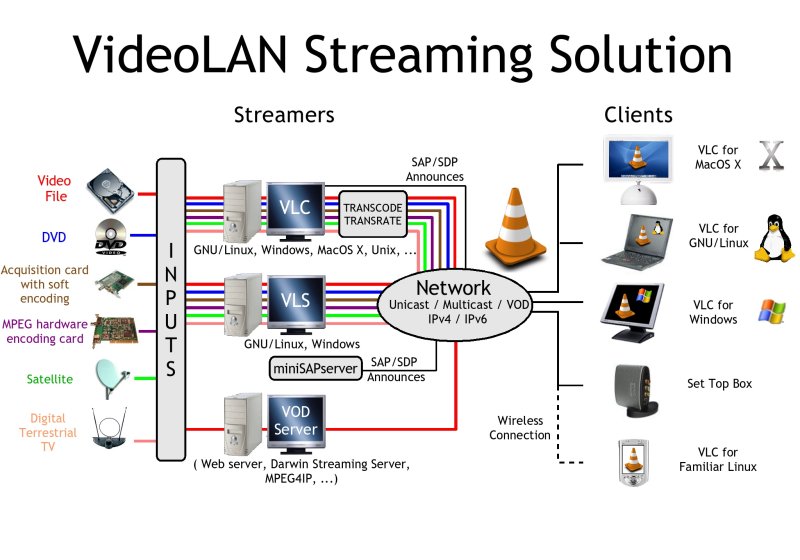
Overview of the VideoLAN streaming solution
The VideoLAN streaming solution includes two programs:
VLC media player which can be used as a server and as a client to stream and receive network streams. VLC is able to stream all that it can read.
VLS (VideoLAN Server), which can stream MPEG-1, MPEG-2 and MPEG-4 files, DVDs, digital satellite channels, digital terrestial television channels and live videos on the network in unicast or multicast. Most of the VLS functionality can now be found VLC. Usage of VLC instead of VLS is advised.
VideoLan Movie Creator Now you see why this project is so important. The feature set and stability of VLC rivals anything that could be purchased, and would expect nothing less, from this open source community project.
What is VLMC?
VideoLAN Movie Creator is a non-linear editing software for video creation based on libVLC and running on Windows, Linux, and MacOSX. Currently in alpha stage, but the more people that use the program the quicker the bugs will get squished out.
This is a VLMC demo from December 2009.
It's not released now as it is unstable, and lacks some key features. Play in HD
This is a new VLMC video presentation.
Made during Fosdem 2010.
As you can see, they added a few things, such as audio support (at last...) some improvements in the GUI, and many little (and some bigger) things here and there !
Don't hesitate to visit the official VideoLAN website, along with the developer's blogs ! www.videolan.org
Celestia is a 3-D astronomy program created by Chris Laurel. The program is based on the Hipparcos Catalogue (HIP) and allows users to travel through an extensive universe, modeled after reality, at any speed, in any direction and at any time in history. Celestia displays and interacts with objects ranging in scale from artificial satellites to entire galaxies in three dimensions using OpenGL, from perspectives which would not be possible from a classic planetarium or other ground based display.
NASA and ESA have used Celestia in their educational and outreach programs, as well as for interfacing to trajectory analysis software.
Celestia is available for Linux, Mac OS X, and Microsoft Windows. Released under the GNU General Public License, Celestia is free software.
Functions
Celestia users can travel/fly through the Celestia universe using simple keyboard controls, at any speed from 0.001m/s to millions of light years/s. Viewpoints can be set to look forward, backward or at any angle to direction of travel. Controls allow users to orbit stars, planets, moons and other space objects, track space objects such as spacecraft, asteroids and comets as they fly by, or travel to and/or fly through nebula and irregular, elliptical and spiral galaxies (over 10,000 galaxies included).
The time simulated by Celestia can be set at any point in the future or past, although planetary orbits are only accurate within a few thousand years of the present day, and date arithmetic overflows at the year 5874774.
The names and positions of multitudes of objects in space can be displayed, from galaxies, star clusters, nebula, constellations and stars to planets, moons, asteroids, comets and artificial satellites, as well as the names and locations of cities, craters, observatories, valleys, landing sites, continents, mountains, seas and other surface features.
Celestia displays such features as detailed atmospheres on planets and moons, planet shine on orbiting satellites, sunsets and sunrises, moving clouds, planetary rings, eclipse and ring shadows, constellation lines, borders and illustrations, night-side lights, detailed surface textures, specular reflections off water and ice, nebula gases and star flares.
Information about the objects that Celestia draws can also be displayed: the radius, the distance, length of the sidereal day and average temperature of the planets are shown and the distance, luminosity relative to the sun, spectral class, surface temperature and radius of stars are indicated.
The user can change Celestia's field of view from as wide as 120 degrees to a highly magnifying 3.4 seconds of arc, while dividing the window into multiple panes, in order to observe several objects at the same time and including Light time delay if desired.
Graphic screen-shots and movies can be captured in classic or HD resolutions (up to 1920x1080) on Windows and Linux platforms.
Celestia's support for game pads and joysticks is relatively limited, employing many keyboard shortcuts instead.
Celestia can be extended with new objects and there are hundreds of third-party, user-created add-ons available for installation, both fictional and realistic. The extension mechanism uses Lua as its built-in scripting language. Educational lessons and computer lesson plans are available.
After a default install Celestia displays the Hipparcos Catalogue (HIP) of almost 120,000 stars. Celestia uses the very accurate VSOP87 theory of planetary orbits. This makes it possible for it to provide a Solar and lunar eclipse finder and to display the orbital paths of planets (including extrasolar planets), dwarf planets, moons, asteroids, comets, artificial satellites, and spacecraft. The user can vary the number of stars that are visible on the screen and have them drawn in different styles.
Addons
About 18 gigabytes of extensions are available in addition to the base program, produced by an active user community.
High resolution surface textures are available for most solar system bodies, including Virtual Textures with complete coverage up to 32768 pixels wide (1.25 km/pixel at the Earth's equator), with selected coverage at higher resolutions. This allows very close views of the Earth, Mars and the Moon. Many 3D models of historical and existing spacecraft are available flying in reasonably accurate trajectories, from Sputnik 1 and Voyager 2 to the Hubble Space Telescope and International Space Station, as are extended data plots for stars (2 million with correct spatial coordinates). DSOs (nebulae, galaxies, open clusters etc), as well as catalogues of thousands of asteroids and comets and more than 96,000 locations on the Earth can be drawn by the program. Add-ons also include extensive space objects such as red and blue supergiants, red and brown dwarfs, neutron stars, spinning pulsars, rotating black holes with accretion disks, protostars, star nursery nebula, supernova and planetary nebula, galactic redshifts, geological planetary displays (e.g. - 3-D interiors, topographic and bathymetric maps, ice age simulations), planetary aurora, rotating magnetic fields, animated solar flares and prominences, 3-D craters and mountains, and historic collision events. All can be visited via the Celestia travel interface. All stages in the life cycle of stars are available, from nebula stage to black dwarf.
Numerous scripts are available; these include simple tours, reconstructions of complex space missions such as Cassini–Huygens and Deep Impact, and scripts showing useful information, like size comparisons, or particular events such as multiple simultaneous eclipses of Jupiter's moons or the evolution of a star.
Many well known fictional universes are depicted in detail, with whole solar systems and 3D models - films such as 2001: A Space Odyssey, Star Trek and Star Wars, and TV shows including Stargate SG-1 and Babylon 5. Addons illustrating less well known Web fiction, like Orion's Arm, and detailed personal works by members of the Celestia community depicting extensive fictional solar systems with inhabited worlds, spacecraft, cities and exotic special effects can also be obtained.
Educational add-ons (built by and for educators) are also available and are in use worldwide. These activities provide approximately 40 hours of space journeys and astronomical lessons, to include extensive tours of the Celestia universe, the complete life cycle of stars, the solar system, the human space program, the Search for Extraterrestrial Intelligence (SETI), and depictions of astronomical events such as the formation of our moon billions of years ago, and the possible terraforming of Mars in the future. A special educational version of the Celestia program can also provide sound effects and "cockpit" features to simulate flying in a "real" hyperdrive spacecraft.
Celestia Can Be Allot Of Fun.
Celestia provides photo-realistic, real-time, three-dimensional viewing of the solar system, the galaxy and the universe. It is an easy to use, freely-distributed, multi-platform, open source, software package which has become a valuable tool for astronomy education. Used in homes, schools, museums and planetariums around the world, it also is used as a visualization tool by space mission designers. Versions are available for computers running Windows, Macintosh (Mac OS X) and Linux operating systems.
Although it is optimized for 3D astronomical visualization, Celestia can be used to display and explore other 3D environments, too.
And, for some reason, many people seem to find exploring with Celestia to be a lot of fun.
Many expect that quantum dot display technology can compete or even replace liquid crystal displays (LCDs) in near future, including the desktop and notebook computer spaces and televisions. These initial applications alone represent more than a $1-billion addressable market by 2012 for quantum dot-based components.
Straight From The Press Release
Nanosys Completes Commercial Agreement with LGIT for its Quantum Rail™ Lighting Products
About Nanosys, Inc.
Nanosys, Inc. is an advanced material architect, harnessing the fundamental properties of inorganic materials into process ready systems that can integrate into existing manufacturing to produce vastly superior products in lighting, electronic displays, solar power, energy storage and medical. For more information, visit www.nanosysinc.com.
Palo Alto, Calif., January 21, 2010 – Nanosys, Inc. today announced that it has signed a definitive commercial agreement with cutting edge electronics component manufacturer LG Innotek (LGIT). The agreement, involving Nanosys' quantum dot phosphors for use in displays, represents the first real world commercial application of quantum dots in electronics.
Use of Nanosys' architected quantum dots enables LGIT to be the first company in the world to provide ultra high color gamut displays to its customers such as LG Group and others. The agreement secures sales of Nanosys' process ready components into the display market for many years.
"Our Quantum Rail™ device takes quantum dots out of the lab and delivers them as process ready components for customers such as LGIT," said Jason Hartlove, CEO of Nanosys. "With a reputation for quick implementation, LGIT is the perfect commercial partner."
Nanosys, Inc. is an advanced material architect, harnessing the fundamental properties of inorganic materials into process ready systems that can integrate into existing manufacturing to produce vastly superior products in lighting, electronic displays, solar power, energy storage and medical. For more information, visit www.nanosysinc.com.
About Quantum Dot
With many promising advantages, QD LED is considered as a next generation display technology. QDs can be incorporated into a new generation of applications such as flat-panel TV screens, digital cameras, mobile phones, personal gaming equipment and PDAs
Quantum dots (QD) are a form of light emitting technology and consist of nano-scale crystals that can provide an alternative for applications such as display technology. This display technology differs from cathode ray tubes (CRTs), liquid crystal displays (LCDs), but it is similar to organic light-emitting diode (OLED) displays, in that light is supplied on demand, which enables new, more efficient displays, which is enabling mobile devices with longer battery lives. Unlike inorganic semiconductor based LEDs, organic electroluminescent devices can be deposited over larger areas and on flexible or non-planar substrates. Large area display or general illumination devices have been fashioned from these molecules and have begun their entry into the market. However, the light emitting organic molecules tend to degrade and are particularly sensitive to humidity and oxidation. Quantum dots incorporate the best aspects of both organic light emitters and inorganic light emitters.
The properties and performance of these unique crystals is determined by the size and/or composition of the QD. Given QDs are both photo-active (photoluminescent) and electro-active (electroluminescent) they can be readily incorporated into new emissive display architectures.
1) Color range: Nanocrystal displays should be able to yield a greater portion of the visible spectrum than current technologies. As shown in the diagram, QD Vision calculates as much as 30% more of the visible spectrum would be available using QDs in a QD-LED vs. a CRT TV.
2) Low power consumption: QD Vision estimates its nanocrystal displays could use 3 to 5% less electrical power than an LCD, in large part because nanocrystal displays don't need a backlight.
3) Vibrant colors: Nanocrystal displays would yield more purity in colors than other types of display technologies. Some display technologies, such as LCDs, can’t create a pure red, green, or blue for the display; instead, they need to add a few other colors to those three to display pure colors. Quantum dots, on the other hand, create pure red, green, and blue to create all other colors.
4) Brightness: 50~100 times brighter than CRT and LCD displays ~40,000 cd/m2
5) Color purity: the color produced by QDs provides for an improved viewing experience for the end user
6) Added flexibility: QDs are soluble in both aqueous and non-aqueous solvents, which provides for printable and flexible displays of all sizes, including large area TVs
7) Improved lifetime: QDs are inorganic, which can give the potential for improved lifetimes when compared to alternative OLED technologies. However, since many parts of QD-LED are made of organic materials, further development is required to improve the functional lifetime.
Other advantages include better saturated green, manufacture ability on polymers, thin display, same material used to generate difference colors, and higher resolution.
Cons
1) Less saturated blue: Blue quantum dot is pretty difficult to manufacture due to the timing control during the reaction. Blue quantum dot is just slightly above the minimum size, where red to green can be easily obtained. Also, human eyes need 50x brighter blue than green in order to detect the same signal.
2) Heat emission: They either emit light or heat, one or the other due to fermions (e- + e+ → photon or heat).
3) Causes overexposure on cameras.
Commercialization of quantum dot display is yet to come. Compared to LCD and OLED, the manufacturing cost of QD-LED is relatively high and development of novel and more cost-efficient fabrication process is desired in future.


 Many expect that quantum dot display technology can compete or even replace liquid crystal displays (LCDs) in near future, including the desktop and notebook computer spaces and televisions. These initial applications alone represent more than a $1-billion addressable market by 2012 for quantum dot-based components.
  With many promising advantages, QD LED is considered as a next generation display technology. QDs can be incorporated into a new generation of applications such as flat-panel TV screens, digital cameras, mobile phones, personal gaming equipment and PDAs
 Pros
Pros