On the BlenderNation website there was a post from a long time Blender user titled
"27 inspirational and jaw dropping Blender creations", by the community of course. After watching them, definitely recommended checking them all out, the longest one was under 10 minutes.
Well 1 of those 27 videos is a music video, it was a good one to. It definitely inspires one to create a music video with Blender. Any who the title for the video is Kopek-Stop and the artists web page is @ Online Portfolio of Eoin Duffy
Don't forget Blender is Open Source Software that is free, there are hundreds of different learning resources that are also free and most of them are great quality. BlenderGuru is one example of great free tutorials. Andrew provides the a base file to start with, and the one he finished, plus other things like the textures are available, and when you open the .blend file it has all the textures and everything down to the layout of the program windows and buttons from the last person who saved the file (again all with free software).
Showing posts with label OpenSource. Show all posts
Showing posts with label OpenSource. Show all posts
Sunday, February 13, 2011
Tuesday, January 4, 2011
New Year!
Hello everyone, it's gonna a be a good New Year, and am looking forward to it. Have been busy with many projects. Am glad to be a member of the OpenShot Video Editor. The project could always use contributors such as translators.
Another project underway is the development of my video game, yet to be named. It is a simple game that has arcade style gameplay made with the help of Unity 3d game engine.
Haven't posted a good AMV in along time so am glad to have found a good one based off of Naruto Shippuden. Just about every AMV for Naruto that I've seen was completely lame, scenes chopped up in windows movie maker and laced with Linkin Park. Every one shoould do them selves a favor and check out the power of Free Software (open source).
----Demonstration of Open Source Software
----AMV
Artist: Tweaker
Music: Doom³ Theme
Anime: Naruto
Another project underway is the development of my video game, yet to be named. It is a simple game that has arcade style gameplay made with the help of Unity 3d game engine.
Haven't posted a good AMV in along time so am glad to have found a good one based off of Naruto Shippuden. Just about every AMV for Naruto that I've seen was completely lame, scenes chopped up in windows movie maker and laced with Linkin Park. Every one shoould do them selves a favor and check out the power of Free Software (open source).
----Demonstration of Open Source Software
----AMV
Artist: Tweaker
Music: Doom³ Theme
Anime: Naruto

Thursday, November 11, 2010
Best of You
In this AMV the creator mixed scenes of the band playing from the real music video into the video with compositing. On Linux it is really easy to do this same effect with a high level of control, only down fall is you got to be able to visualize what you want, it's a good idea to think about this and try to draw it out or write it out on paper.
So here it is an a nutshell, we open a blank image in Inkscape and use black and white, then open that in say, OpenShot and select which color to make transparent. It is as easy as that, and with the help of key frames that image can be animated across the screen, like a moving window to the background layer of video.
Song: Best of You
Artist: Foo Fighters
Anime: Various
So here it is an a nutshell, we open a blank image in Inkscape and use black and white, then open that in say, OpenShot and select which color to make transparent. It is as easy as that, and with the help of key frames that image can be animated across the screen, like a moving window to the background layer of video.
Song: Best of You
Artist: Foo Fighters
Anime: Various
Wednesday, September 15, 2010
OpenShot Basics
The developer of OpenShot has made a commitment to stick with three basic criteria for his application they are: easy to use, stable, powerful. Well Jonathon has done just that, I would recommend this program to an average pc user, it has been stable since before 1.0, and with the compositing feature and high definition capability it is just as powerful as any proprietary video editor. In fact I'd argue that it gets more power from the hardware seeing as it as a native Linux application.
Fun fact; if you go to Pixar's website to purchase software for digital animation you can choose between Linux, Mac-OSX and Windows, and chances are the server farms are all running Linux. Although the real cool thing is that one of the artists (Windows clients) can connect to the server (Linux), and have it take care of its' processing needs.
Here is a quick demonstration of using OpenShot. In the video you will see adding files to the time-line, zooming in and out in the time-line, using layers, adding transitions creating a title and credits, and exporting. This was made with version 0.8.2, the current release is 1.2 and has made exporting simpler, and added an easy way to add 3d text.
Screencast of OpenShot 0.8.2 from Jonathan Thomas on Vimeo.
As seen above this software is really simple, but the use of layers and compositing the potential to create something amazing is there. Look forward to more on OpenShot
Fun fact; if you go to Pixar's website to purchase software for digital animation you can choose between Linux, Mac-OSX and Windows, and chances are the server farms are all running Linux. Although the real cool thing is that one of the artists (Windows clients) can connect to the server (Linux), and have it take care of its' processing needs.
Here is a quick demonstration of using OpenShot. In the video you will see adding files to the time-line, zooming in and out in the time-line, using layers, adding transitions creating a title and credits, and exporting. This was made with version 0.8.2, the current release is 1.2 and has made exporting simpler, and added an easy way to add 3d text.
Screencast of OpenShot 0.8.2 from Jonathan Thomas on Vimeo.
As seen above this software is really simple, but the use of layers and compositing the potential to create something amazing is there. Look forward to more on OpenShot
Saturday, August 28, 2010
Latest from Nostromo
By far Nostromo is one of the best AMV creators ever. He or she, has such an artistic touch, from the coloring to the syncing of a particular visual with sound, oh and don't forget the skills in so many apps. To make an AMV like this a photo manipulation program, audio editor, and a non-linear video editor is required. Any who it is a great video.
Anime: Bakemonogatari
Music: Yuksek - Tonight (+Nostromix)
Editor: Nostromo
Anime: Bakemonogatari
Music: Yuksek - Tonight (+Nostromix)
Editor: Nostromo
Tuesday, May 11, 2010
Cinelerra Tutorials Continued

Learn about how to install Cinelerra at its' homepage I'd recommend trying out the Elive live-cd, if you are a windows user. All you do is burn the cd and restart your pc into a fully functional production system.
Currently to achieve what Cinelerra does in windows, one would have to purchase more then one application (a video editor & compositor). Then for more advanced effects, a photo manipulation program would be required, which would be another cost. In my honest opinion windows software just can't match the power of open source. One example off the top of my head is the render-farm feature. With Linux it is real easy to have twenty pcs all hooked up to the same network in such a way where they work together. In fact it just might be to easy.
Tutorial Time
Every video needs credits, it just wouldn't be nice to not give credit where credit is due. So let's go over a simple yet extremely powerful method for adding text. Of course with a little playing around you could have the same sliding text like the Star Wars Movie. If you go back to the previous post, there is a tutorial of title. One of the ways to add titles was to put in keyframes and type in between them to make it look like you were typing in the video, really cool.
What makes this method so powerful is that, it's extremely easy to make it look however it was imagined. From creating your custom font just for the video, to having it scrolling over a video, or ever spinning around a center point in 3d, like the rings of Saturn. "If theres a will there a way" I like to say.
Scrolling Text Pt1
Scolling Text Pt2
So, bet you are already working on your text, know I was ready to begin after watching. There will be more tutorials to come, such as picture in picture and motion tracking to start off.
Friday, April 2, 2010
Papagayo and Synfig

Designed to help you line up phonemes (mouth shapes) with the actual recorded sound of actors speaking. Papagayo makes it easy to lip sync animated characters by making the process very simple - just type in the words being spoken (or copy/paste them from the animation's script), then drag the words on top of the sound's waveform until they line up with the proper sounds.
After syncing up mouth shapes with actual sounds, Papagayo can then export the result for use with Anime Studio, their 2D animation product. I couldn't find the Linux version though. I am trying Synfig.
Papagayo is free to download and use. Sync 'till your virtual lips are sore! Papagayo is available for Windows, Mac OS X, and Linux. Download @ Lost Marble


Synfig is a powerful, industrial-strength vector-based open-source 2D animation software package, designed from the ground-up for producing feature-film quality animation with fewer people and resources. While there are many other programs currently on the market to aid with the efficient production of 2D animation, there currently is not any other software that can do what this software can.
2D Animation has traditionally been very expensive because every frame must be drawn by hand. Even with today's digital inking and painting software, the process still relies on individuals hand-drawing each frame. This laborious task is called "tweening".
Synfig eliminates the task of manual tweening, producing smooth, fluid motion without the animator having to draw out each frame individually. This allows you to produce 2D animation with fewer people while producing art of a higher quality. Download @ Tux Family
Synfig Demo Reel

Wednesday, March 17, 2010
OpenShot 1.1!
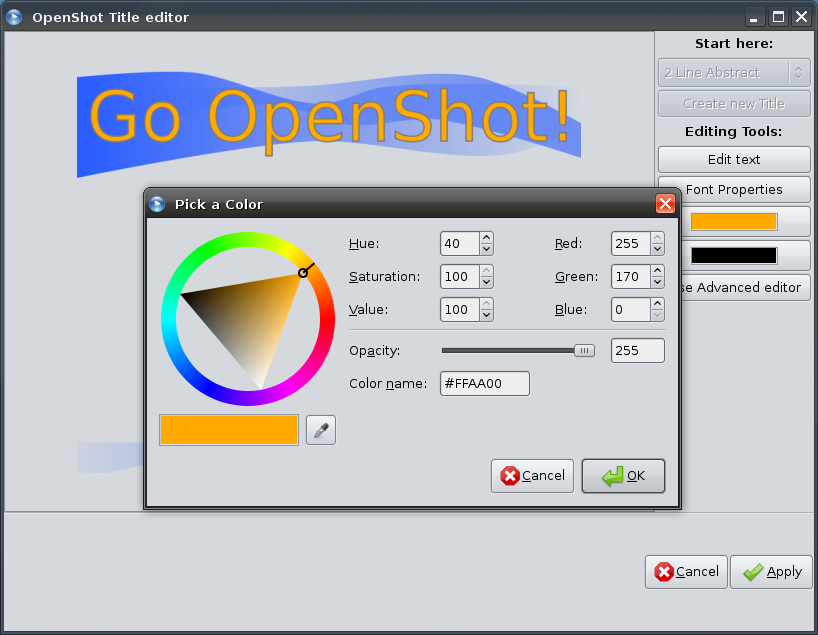
About OpenShot
Behind every great program, is a great story. Well... I'm not sure if this is a great story or not, but here it is. The author's name is Jonathan Thomas. He is a resident of Arlington, TX, USA. Jonathan Thomas is a professional software / web developer (12+ years experience).In early 2008, Jonathon first installed Ubuntu. He was very impressed, but like many people, realized immediately the lack of a video editor. For weeks he researched, downloaded, configured, compiled, and installed any Linux video editor I could find. It turns out there are many, but none that met his simple criteria.
- easy to use
- stable
- powerful
It doesn't get much easier then OpenShot, not that microsoft movie maker ins't easy, it's just that it only gives has two options, so it doesn't even count. With openshot, adding a slideshow is super easy, but you can spend hours making look the way you want, by adjusting transitions, picture in picture, add text, and more.
Another cool feature is, you can edit a picture that is black and white, and open shot will fade the shape of your pick, in or out.
OpenShot 1.1.0 Released! from Jonathan Thomas on Vimeo.
It seems that open-sourcing his project was a good idea, because the project has been moving ahead of schedule.
- Support for many video, audio, and image formats (based on FFmpeg)
- Gnome integration (drag and drop support)
- Multiple tracks
- Clip resizing, trimming, snapping, and cutting
- Video transitions with real-time previews
- Compositing, image overlays, watermarks
- Title templates, title creation
- SVG friendly, to create and include titles and credits
- Scrolling motion picture credits
- Solid color clips (including alpha compositing)
- Support for Rotoscoping / Image sequences
- Drag and drop timeline
- Frame stepping, key-mappings: J,K, and L keys
- Video encoding (based on FFmpeg)
- Key Frame animation
- Digital zooming of video clips
- Speed changes on clips (slow motion etc)
- Custom transition lumas and masks
- Re-sizing of clips (frame size)
- Audio mixing and editing
- Presets for key frame animations and layout
- Ken Burns effect (making video by panning over an image)
- Digital video effects, including brightness, gamma, hue, greyscale, chroma key (bluescreen / greenscreen), and over 20 other video effects
Screencast of OpenShot Chroma-Key Effect
Screencast of OpenShot Chroma-Key Effect from Jonathan Thomas on Vimeo.
OpenShot Key-Frame Demo!
Getting to understand and use key-frames is very important for getting into more advanced control over your videos. Say I put a thirdy second clip in the timeline. A key-frame can be placed at, the five second mark and another at the end, and then set it to fade, rotate, zoom, and many other thing much more precisely with key-frames.
OpenShot Has Effects!!!
There are plenty of effects to add, and most of them have multiple variable
settings.
OpenShot Video Gets Effects!!! from Jonathan Thomas on Vimeo.
settings.
OpenShot Video Gets Effects!!! from Jonathan Thomas on Vimeo.
Friday, February 19, 2010
Check Out the Celestia
Celestia is a 3-D astronomy program created by Chris Laurel. The program is based on the Hipparcos Catalogue (HIP) and allows users to travel through an extensive universe, modeled after reality, at any speed, in any direction and at any time in history. Celestia displays and interacts with objects ranging in scale from artificial satellites to entire galaxies in three dimensions using OpenGL, from perspectives which would not be possible from a classic planetarium or other ground based display.
NASA and ESA have used Celestia in their educational and outreach programs, as well as for interfacing to trajectory analysis software.
 Celestia is available for Linux, Mac OS X, and Microsoft Windows. Released under the GNU General Public License, Celestia is free software.
Functions
Celestia users can travel/fly through the Celestia universe using simple keyboard controls, at any speed from 0.001m/s to millions of light years/s. Viewpoints can be set to look forward, backward or at any angle to direction of travel. Controls allow users to orbit stars, planets, moons and other space objects, track space objects such as spacecraft, asteroids and comets as they fly by, or travel to and/or fly through nebula and irregular, elliptical and spiral galaxies (over 10,000 galaxies included).
The time simulated by Celestia can be set at any point in the future or past, although planetary orbits are only accurate within a few thousand years of the present day, and date arithmetic overflows at the year 5874774.
The names and positions of multitudes of objects in space can be displayed, from galaxies, star clusters, nebula, constellations and stars to planets, moons, asteroids, comets and artificial satellites, as well as the names and locations of cities, craters, observatories, valleys, landing sites, continents, mountains, seas and other surface features.
Celestia displays such features as detailed atmospheres on planets and moons, planet shine on orbiting satellites, sunsets and sunrises, moving clouds, planetary rings, eclipse and ring shadows, constellation lines, borders and illustrations, night-side lights, detailed surface textures, specular reflections off water and ice, nebula gases and star flares.
Information about the objects that Celestia draws can also be displayed: the radius, the distance, length of the sidereal day and average temperature of the planets are shown and the distance, luminosity relative to the sun, spectral class, surface temperature and radius of stars are indicated.
The user can change Celestia's field of view from as wide as 120 degrees to a highly magnifying 3.4 seconds of arc, while dividing the window into multiple panes, in order to observe several objects at the same time and including Light time delay if desired.
Graphic screen-shots and movies can be captured in classic or HD resolutions (up to 1920x1080) on Windows and Linux platforms.
Celestia's support for game pads and joysticks is relatively limited, employing many keyboard shortcuts instead.
Celestia can be extended with new objects and there are hundreds of third-party, user-created add-ons available for installation, both fictional and realistic. The extension mechanism uses Lua as its built-in scripting language. Educational lessons and computer lesson plans are available.
After a default install Celestia displays the Hipparcos Catalogue (HIP) of almost 120,000 stars. Celestia uses the very accurate VSOP87 theory of planetary orbits. This makes it possible for it to provide a Solar and lunar eclipse finder and to display the orbital paths of planets (including extrasolar planets), dwarf planets, moons, asteroids, comets, artificial satellites, and spacecraft. The user can vary the number of stars that are visible on the screen and have them drawn in different styles.
Addons
About 18 gigabytes of extensions are available in addition to the base program, produced by an active user community.
High resolution surface textures are available for most solar system bodies, including Virtual Textures with complete coverage up to 32768 pixels wide (1.25 km/pixel at the Earth's equator), with selected coverage at higher resolutions. This allows very close views of the Earth, Mars and the Moon. Many 3D models of historical and existing spacecraft are available flying in reasonably accurate trajectories, from Sputnik 1 and Voyager 2 to the Hubble Space Telescope and International Space Station, as are extended data plots for stars (2 million with correct spatial coordinates). DSOs (nebulae, galaxies, open clusters etc), as well as catalogues of thousands of asteroids and comets and more than 96,000 locations on the Earth can be drawn by the program. Add-ons also include extensive space objects such as red and blue supergiants, red and brown dwarfs, neutron stars, spinning pulsars, rotating black holes with accretion disks, protostars, star nursery nebula, supernova and planetary nebula, galactic redshifts, geological planetary displays (e.g. - 3-D interiors, topographic and bathymetric maps, ice age simulations), planetary aurora, rotating magnetic fields, animated solar flares and prominences, 3-D craters and mountains, and historic collision events. All can be visited via the Celestia travel interface. All stages in the life cycle of stars are available, from nebula stage to black dwarf.
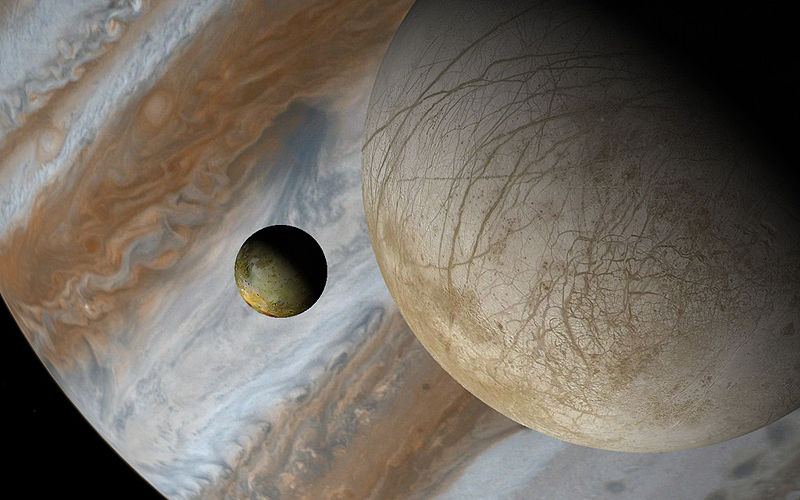
Numerous scripts are available; these include simple tours, reconstructions of complex space missions such as Cassini–Huygens and Deep Impact, and scripts showing useful information, like size comparisons, or particular events such as multiple simultaneous eclipses of Jupiter's moons or the evolution of a star.
Many well known fictional universes are depicted in detail, with whole solar systems and 3D models - films such as 2001: A Space Odyssey, Star Trek and Star Wars, and TV shows including Stargate SG-1 and Babylon 5. Addons illustrating less well known Web fiction, like Orion's Arm, and detailed personal works by members of the Celestia community depicting extensive fictional solar systems with inhabited worlds, spacecraft, cities and exotic special effects can also be obtained.
Educational add-ons (built by and for educators) are also available and are in use worldwide. These activities provide approximately 40 hours of space journeys and astronomical lessons, to include extensive tours of the Celestia universe, the complete life cycle of stars, the solar system, the human space program, the Search for Extraterrestrial Intelligence (SETI), and depictions of astronomical events such as the formation of our moon billions of years ago, and the possible terraforming of Mars in the future. A special educational version of the Celestia program can also provide sound effects and "cockpit" features to simulate flying in a "real" hyperdrive spacecraft.
Celestia Can Be Allot Of Fun.
Celestia provides photo-realistic, real-time, three-dimensional viewing of the solar system, the galaxy and the universe. It is an easy to use, freely-distributed, multi-platform, open source, software package which has become a valuable tool for astronomy education. Used in homes, schools, museums and planetariums around the world, it also is used as a visualization tool by space mission designers. Versions are available for computers running Windows, Macintosh (Mac OS X) and Linux operating systems.
Although it is optimized for 3D astronomical visualization, Celestia can be used to display and explore other 3D environments, too.
And, for some reason, many people seem to find exploring with Celestia to be a lot of fun.
NASA and ESA have used Celestia in their educational and outreach programs, as well as for interfacing to trajectory analysis software.
Functions
Celestia users can travel/fly through the Celestia universe using simple keyboard controls, at any speed from 0.001m/s to millions of light years/s. Viewpoints can be set to look forward, backward or at any angle to direction of travel. Controls allow users to orbit stars, planets, moons and other space objects, track space objects such as spacecraft, asteroids and comets as they fly by, or travel to and/or fly through nebula and irregular, elliptical and spiral galaxies (over 10,000 galaxies included).
The time simulated by Celestia can be set at any point in the future or past, although planetary orbits are only accurate within a few thousand years of the present day, and date arithmetic overflows at the year 5874774.
The names and positions of multitudes of objects in space can be displayed, from galaxies, star clusters, nebula, constellations and stars to planets, moons, asteroids, comets and artificial satellites, as well as the names and locations of cities, craters, observatories, valleys, landing sites, continents, mountains, seas and other surface features.
Celestia displays such features as detailed atmospheres on planets and moons, planet shine on orbiting satellites, sunsets and sunrises, moving clouds, planetary rings, eclipse and ring shadows, constellation lines, borders and illustrations, night-side lights, detailed surface textures, specular reflections off water and ice, nebula gases and star flares.
Information about the objects that Celestia draws can also be displayed: the radius, the distance, length of the sidereal day and average temperature of the planets are shown and the distance, luminosity relative to the sun, spectral class, surface temperature and radius of stars are indicated.
The user can change Celestia's field of view from as wide as 120 degrees to a highly magnifying 3.4 seconds of arc, while dividing the window into multiple panes, in order to observe several objects at the same time and including Light time delay if desired.
Graphic screen-shots and movies can be captured in classic or HD resolutions (up to 1920x1080) on Windows and Linux platforms.
Celestia's support for game pads and joysticks is relatively limited, employing many keyboard shortcuts instead.
Celestia can be extended with new objects and there are hundreds of third-party, user-created add-ons available for installation, both fictional and realistic. The extension mechanism uses Lua as its built-in scripting language. Educational lessons and computer lesson plans are available.
After a default install Celestia displays the Hipparcos Catalogue (HIP) of almost 120,000 stars. Celestia uses the very accurate VSOP87 theory of planetary orbits. This makes it possible for it to provide a Solar and lunar eclipse finder and to display the orbital paths of planets (including extrasolar planets), dwarf planets, moons, asteroids, comets, artificial satellites, and spacecraft. The user can vary the number of stars that are visible on the screen and have them drawn in different styles.
Addons
About 18 gigabytes of extensions are available in addition to the base program, produced by an active user community.
High resolution surface textures are available for most solar system bodies, including Virtual Textures with complete coverage up to 32768 pixels wide (1.25 km/pixel at the Earth's equator), with selected coverage at higher resolutions. This allows very close views of the Earth, Mars and the Moon. Many 3D models of historical and existing spacecraft are available flying in reasonably accurate trajectories, from Sputnik 1 and Voyager 2 to the Hubble Space Telescope and International Space Station, as are extended data plots for stars (2 million with correct spatial coordinates). DSOs (nebulae, galaxies, open clusters etc), as well as catalogues of thousands of asteroids and comets and more than 96,000 locations on the Earth can be drawn by the program. Add-ons also include extensive space objects such as red and blue supergiants, red and brown dwarfs, neutron stars, spinning pulsars, rotating black holes with accretion disks, protostars, star nursery nebula, supernova and planetary nebula, galactic redshifts, geological planetary displays (e.g. - 3-D interiors, topographic and bathymetric maps, ice age simulations), planetary aurora, rotating magnetic fields, animated solar flares and prominences, 3-D craters and mountains, and historic collision events. All can be visited via the Celestia travel interface. All stages in the life cycle of stars are available, from nebula stage to black dwarf.
Numerous scripts are available; these include simple tours, reconstructions of complex space missions such as Cassini–Huygens and Deep Impact, and scripts showing useful information, like size comparisons, or particular events such as multiple simultaneous eclipses of Jupiter's moons or the evolution of a star.
Many well known fictional universes are depicted in detail, with whole solar systems and 3D models - films such as 2001: A Space Odyssey, Star Trek and Star Wars, and TV shows including Stargate SG-1 and Babylon 5. Addons illustrating less well known Web fiction, like Orion's Arm, and detailed personal works by members of the Celestia community depicting extensive fictional solar systems with inhabited worlds, spacecraft, cities and exotic special effects can also be obtained.
Educational add-ons (built by and for educators) are also available and are in use worldwide. These activities provide approximately 40 hours of space journeys and astronomical lessons, to include extensive tours of the Celestia universe, the complete life cycle of stars, the solar system, the human space program, the Search for Extraterrestrial Intelligence (SETI), and depictions of astronomical events such as the formation of our moon billions of years ago, and the possible terraforming of Mars in the future. A special educational version of the Celestia program can also provide sound effects and "cockpit" features to simulate flying in a "real" hyperdrive spacecraft.
Celestia Can Be Allot Of Fun.
Celestia provides photo-realistic, real-time, three-dimensional viewing of the solar system, the galaxy and the universe. It is an easy to use, freely-distributed, multi-platform, open source, software package which has become a valuable tool for astronomy education. Used in homes, schools, museums and planetariums around the world, it also is used as a visualization tool by space mission designers. Versions are available for computers running Windows, Macintosh (Mac OS X) and Linux operating systems.
Although it is optimized for 3D astronomical visualization, Celestia can be used to display and explore other 3D environments, too.
And, for some reason, many people seem to find exploring with Celestia to be a lot of fun.
Sunday, January 31, 2010
Deeper Than Words
A Classic AMV by Nostromo, Arjuna - Nature's Kingdom.
Song: kai tracid Conscious
Anime: Arjuna (Earth Girl Arjuna)
Watch On Youtube
The story opens with Juna telling her boyfriend Tokio she feels too cramped in the city, and deciding to take a trip to the Sea of Japan. On the drive, they get in an accident and Juna dies. As the spirit leaves her body, Juna sees the dying Earth. The planet's suffering is visualized by worm-like creatures, the Raaja. The Raaja vary in size, from microscopic bacteria to those entwining the planet. A young boy named Chris appears before Juna and offers to save her life if she will help the planet. She agrees and is resurrected.
As is clear from the title, Arjuna, the series is highly influenced by Hinduism, as well as Indian culture in general. The story was inspired by the Bhagavad Gita, most notably in the character of Chris, who is modeled after Krishna.
The setting for the show, Kobe, was chosen by creator Shoji Kawamori for his personal fondness of it, and the city itself plays a prominent role, with famous buildings such as the Kobe Meriken Park Oriental Hotel and nearby Ferris wheel showing up as common backdrops. The idea of living in a city is a main theme, with both Juna and the Raaja rebelling against how removed from nature modern life is.
An idea which Kawamori emphasized was natural farming. Not to be confused with the mere absence of chemicals that is often meant by "organic farming", natural farming involves letting nature grow as it will, not removing weeds or bugs, or using any fertilizer. The old man Juna encounters in episode four explains the need for this return to nature in order to sustain life in the long term, a sentiment directly from Kawamori himself
The show contains some very scientific and current elements which include the pole shift hypothesis, the Van Allen Belt, Fermat's Last Theorem, etc.
In episode two, Chris's chakras are shown on the monitor screen which are also adapted from the Hindu concept of 7 chakras inside the human body.

The Unseen In This AMV
Even for those the have seen the series, this is something that isn't obvious, unless you know what you are looking at. That object on her head, the shape of a sphere with a flowing tail is still to this day, the usual visual representation of the human spirit in Japan.The Magatama First appeared during the Jōmon period, which was from about 14,000 BCE to 400 BCE..
There is also a strong resemblance with the Magatama and the Gentoo Linux icon.
 Gentoo Linux is a computer operating system built on top of the Linux kernel and based on the Portage package management system. It is distributed as free and open source software. Unlike a conventional software distribution, the user compiles the source code locally according to their chosen configuration. There are normally no precompiled binaries for software, continuing the tradition of the ports collection, although for convenience, some software packages (such as Mozilla Firefox and OpenOffice) are also available as precompiled binaries for various architectures where compiling would otherwise be very time consuming. The development project and its products are named after the Gentoo penguin. Gentoo package management is designed to be modular, portable, easy to maintain, flexible, and optimized for the user's machine. Gentoo describes itself as a metadistribution, "because of its near-unlimited adaptability".
Whats in a name?
 Arjuna is a medicinal plant of the genus Terminalia, widely used by Ayurvedic physicians for its curative properties in organic/functional heart problems including angina, hypertension and deposits in arteries. According to Ayurvedic texts it also very useful in the treatment of any sort of pain due a fall, ecchymosis (bruises), spermatorrhoea and sexually transmitted diseases such as gonorrhoea. Arjuna bark (Terminallia arjuna) is thought to be beneficial for the heart. This has also been proved in a research by Dr. K. N. Udupa in Banaras Hindu University's Institute of Medical Sciences , Varanasi (India). In this research, they found that powdered extract of the above drug provided very good results to the people suffering from Coronary heart diseases
Song: kai tracid Conscious
Anime: Arjuna (Earth Girl Arjuna)
Watch On Youtube
About Arjuna
As is clear from the title, Arjuna, the series is highly influenced by Hinduism, as well as Indian culture in general. The story was inspired by the Bhagavad Gita, most notably in the character of Chris, who is modeled after Krishna.
The setting for the show, Kobe, was chosen by creator Shoji Kawamori for his personal fondness of it, and the city itself plays a prominent role, with famous buildings such as the Kobe Meriken Park Oriental Hotel and nearby Ferris wheel showing up as common backdrops. The idea of living in a city is a main theme, with both Juna and the Raaja rebelling against how removed from nature modern life is.
An idea which Kawamori emphasized was natural farming. Not to be confused with the mere absence of chemicals that is often meant by "organic farming", natural farming involves letting nature grow as it will, not removing weeds or bugs, or using any fertilizer. The old man Juna encounters in episode four explains the need for this return to nature in order to sustain life in the long term, a sentiment directly from Kawamori himself
The show contains some very scientific and current elements which include the pole shift hypothesis, the Van Allen Belt, Fermat's Last Theorem, etc.
In episode two, Chris's chakras are shown on the monitor screen which are also adapted from the Hindu concept of 7 chakras inside the human body.

The Unseen In This AMV
Even for those the have seen the series, this is something that isn't obvious, unless you know what you are looking at. That object on her head, the shape of a sphere with a flowing tail is still to this day, the usual visual representation of the human spirit in Japan.The Magatama First appeared during the Jōmon period, which was from about 14,000 BCE to 400 BCE..
There is also a strong resemblance with the Magatama and the Gentoo Linux icon.

 Arjuna is a medicinal plant of the genus Terminalia, widely used by Ayurvedic physicians for its curative properties in organic/functional heart problems including angina, hypertension and deposits in arteries. According to Ayurvedic texts it also very useful in the treatment of any sort of pain due a fall, ecchymosis (bruises), spermatorrhoea and sexually transmitted diseases such as gonorrhoea. Arjuna bark (Terminallia arjuna) is thought to be beneficial for the heart. This has also been proved in a research by Dr. K. N. Udupa in Banaras Hindu University's Institute of Medical Sciences , Varanasi (India). In this research, they found that powdered extract of the above drug provided very good results to the people suffering from Coronary heart diseases
Monday, January 18, 2010
A Classics, One of the Best - G.I.T.S.
Ghost in the Shell.

The setting of Ghost in the Shell is cyberpunk or postcyberpunk, similar to that of William Gibson's Sprawl trilogy. Kusanagi and her colleagues face external threats and also suffer internal conflict over their own natures.
Ghost in the Shell made an impression on a number of filmmakers. Larry and Andy Wachowski, the creators of The Matrix and its sequels, showed it to producer Joel Silver, saying "we wanna do that for real." Director James Cameron has called it "the first truly adult animation film to reach a level of literary and visual excellence."
Overview
Ghost in the Shell takes place in the year 2029, when the world has become interconnected by a vast electronic network that permeates every aspect of life. People also tend to rely more and more on cybernetic implants and the first strong AIs make their appearance. The main entity presented in the various media is the Public Security Section 9 police force, which is charged to investigate cases like the Puppet Master and the Laughing Man.Yet, as those criminals are revealed to have more depth than was at first apparent, the various protagonists are left with disturbing questions: What exactly is the definition of human in a society where a mind can be copied and the body replaced with a fully synthetic body? What, exactly, is the "ghost" — the essence — in the cybernetic "shell"? Where is the boundary between human and machine when the differences between the two become more philosophical than physical?
Philosophical elements
Ghosts
In Ghost in the Shell, the word ghost is colloquial slang for an individual's consciousness. In the manga's futuristic society, science has redefined the ghost as the thing that differentiates a human being from a biological robot. Regardless of how much biological material is replaced with electronic or mechanical substitutes, as long as individuals retain their ghost, they retain their humanity and individuality.The concept of the ghost was borrowed by Masamune Shirow from an essay on structuralism, "The Ghost in the Machine" by Arthur Koestler. The title The Ghost in the Machine itself was originally used by an English philosopher, Gilbert Ryle to mock the paradox of conventional Cartesian dualism and Dualism in general. Koestler, like Ryle, denies Cartesian dualism and locates the origin of human mind in the physical condition of the brain. He argues that the human brain has grown and built upon earlier, more primitive brain structures, the "ghost in the machine", which at times overpower higher logical functions, and are responsible for hate, anger and other such destructive impulses. Shirow denies dualism similarly in his work, but defines the "ghost" more broadly, not only as a physical trait, but as a phase or phenomenon that appears in a system at a certain level of complexity. The brain itself is only part of the whole neural network; if, for example, an organ is removed from a body, the autonomic nerve of the organ and consequently its "ghost" will vanish unless the stimulus of the existence of the organ is perfectly re-produced by a mechanical substitution. This can be compared, by analogy, to a person born with innate deafness being unable to understand the concept of "hearing" unless taught.
Ghost-dubbing, or duplicating a ghost, is a near-impossible act in the Ghost in the Shell universe. When performed, as a cheap AI substitute in Innocence and earlier in the manga, the result is always inferior to the original-which always dies in the process. In Stand Alone Complex, criminals use a ghost-dubbing device to create numerous duplicates of South American drug lord Marcelo Jarti; after the original died, the device continued to duplicate him into a near-infinite number of bodies with identical memories and personalities, essentially immortalizing him.
In Ghost in the Shell, Kusanagi completely reproduces the stimulus of all of her organs in order to maintain her "ghost". If a technical error arises during the transfer of a "ghost" from one body to another, the transfer normally results in failure, since the "ghost" tends to deteriorate due to either the difference of system at the material level or the deficiency of the transferring protocol. The Puppet Master manages not to deteriorate its "ghost" when merging with Kusanagi because his system is the body of information itself, thereby avoiding a deterioration due to the deficiency at material level.
The Ancient Greeks had a similar paradox, called the Ship of Theseus. Hegel's concept of Geist may also be related.
Birth
Another interpretation of the fusion of Kusanagi and the Puppet Master is analogous to the concept of birth; whereby two separate entities create a third entity which is not the same as either of the originating ghosts or DNA sets but shares common traits. The Puppet Master carefully explains that diversity is the only way that he can continue; no matter how many times he copies himself, a trick, virus, or weakness discovered that destroys any of his copies could destroy them all. He quite specifically asks her to fuse her "ghost" or "soul" with his own, a form of marriage/birth in which the resultant being is neither the Puppet Master nor Kusanagi but a new being entirely. Notice the symbolism in the movie when Kusanagi/Puppet Master gets a new body - that of a child. This touches upon concepts of birth, immortality through progeny, and the union of two ghosts/people in the creation of progeny. Interestingly enough, her new body in the original manga is instead a male body. She also states that this new life-form will create children, as well.Connectivity
When Motoko merges with project 2501 (puppet master) she changes. The definition of this change, and what it will actually bring for her and for the world is, unfortunately, hidden very well in various pieces of dialogue and even scarcer visual analogies throughout the films, series, and manga. Focusing first on the film, where Mamoru Oshi took a very different stance in what themes he would emphasize and how he would emphasize them, the best place to look is in the conversation between the Puppet Master and the Major before they join."I am connected to a vast network, of which l myself am a part. To one like you, who cannot access it, you may perceive it only as light. As we are confined to our one section, so we are all connected. Limited to a small part of our functions. But now we must slip our bonds, and shift to the higher structure."
He then ends with "It is time to become a part of everything."
He is essentially saying, as he is a creature of information, he has fewer limits. He is in theory, not bound by any one form, however in reality, he is incapable of changing. The logic behind this is that, he is so fluid, in a world (the net) which is so fluid, motion is in itself stunted. By merging with Motoko, half of his 'vision' and his 'ability to see clearly the whole' will go to her, and her limited functions will help give the new being a shape, and a definition, which will allow it to seriously 'elevate' to expansion.
All her life, Motoko has wanted to be free of her anxieties about her origins and her frail human definition, but she has been so afraid of losing what little humanity she has, she is in quite a pathetic position, a sour one in any case, and one where she is incapable of undergoing any kind of change. So she will always possess those anxieties. Project 2501 doesn't give her a choice exactly, but she probably would have made it anyway, because it means she is freed of 'worldly' bonds and illusions, and is finally able to connect with her past and future, which define the present, rather than be locked in the current confined and retracted world she lives in.
'It is time to become a part of everything' is clearly referring to a sense of community and connectivity among everything in the world, and can be related to the ideas expressed in Zen Buddhism, and the Japanese culture, where there is a strong mentality of being part of whole, rather than alone as an individual. We are, and this is obvious when you look around, becoming increasingly isolated to our own worlds, our own desires and plans for life, and we can be so obsessed with what we're doing, we don't notice the intricate and beautiful patterns around us. We preach to the inverted, and we achieve less as individuals, and less as a group. Motoko, though deeply philosophical, is still a victim of this.
Project 2501 puts it into his own technical situation, saying that each entity is confined to its own section (task, purpose, desire) and that because of this each entity can call itself its own, even 2501. He is not suggesting that this is a bad thing, or that we can or should be everything, because such a concept would contradict everything else he talks about. He is merely expressing the traditional value that we can, as beings, as humans, live a much fuller life by recognizing we are a part of everything. All it takes is recognition, and we can attain a kind of enlightenment. This is what connectivity means. We can feel more relaxed, which Motoko clearly does, more at ease with herself, and somewhat excited about the world of possibilities for her.
Cyberbrain warfare and ghost hacking
Cyberbrain warfare is the practice of employing ghost hacking as a means of gaining access to an opponent's cyberbrain, and ultimately, their ghost. A successful cyberhacker can intercept, censor, or augment the sensory information being received by a victim, or even go so far as to destroy or rewrite complete memories. Furthermore, a person's cyberbrain can be directly injured, by making the cyberbrain undergo unaffordable computation and thus overheat. (See Cordwainer Smith's "The Burning of the Brain")Cyberbrain warfare is portrayed as a natural consequence of the integration of cybernetic and wireless communication technology directly into the human brain. Despite the apparent risks, even the most paranoid characters in the story find the benefits of directly networking their brains to be indispensable.
Apparently, any conduit by which information is absorbed by the brain can be exploited for ghost hacking. Shirow envisions the use of firewalls for protecting the ghost against attack, and multiple layers of encryption.
Mnemonic devices
Much like information stored in the hard-drive of a modern computer, the memories of a ghost can become fragmented and unreliable. This is the result of ghost-hacking, psychological treatment, trauma experienced while ghost-diving, corrupted transference from one cyber-brain to another, and the degradation of memories as they are collected and cross-referenced over the course of a lifetime.The response that humans have developed to cope with the confusion of memories is to reinforce them with external reminders. Artwork, books, clothing, personal electronics, places of employment, and even companions are carefully chosen to familiarize the landscape of one's existence. In a sense we are partly motivated in our actions by the desire to look back on them with fondness and clarity.
The need for these mnemonic devices is also a philosophical hurdle for the members of Section 9. They are, after all, a watchdog group mandated with rooting out cases of cyber-brain crime. Kusanagi shuns the accumulation of trinkets (beyond the watch she wears in Stand Alone Complex). Being an expert in ghost-hacking and the workings of the cyber-brain, she considers these to be a sign of weakness that can be easily read by enemies. In an age when a detective can reconstruct a person's psyche based on study of their external memory Kusanagi has a sound position. Even she, however, still keeps that one single watch, and still keeps the same model of cybernetic body.
Batou, on the other hand, is sentimental. He keeps a pet dog, has safe houses full of books and art, lifts weights despite it being pointless (due to the fact he is a full cyborg thus lacking organic muscle tissue), and even has a favorite Tachikoma to work with. Though they may be a fatal indication of one's living habits in his line of work he still clings to such comforts.
External memory
External memory is exactly that: memories and experiences that are stored "offline" onto a hard disk or such. If you possess a cyber brain (as the most of affluent in the 'Ghost in the Shell' universe do), there is a definite separation of mind and body since your brain case can be removed and put into a new body. Since there is an electronic separation, the signals received from the senses (touch, taste, etc.) can be recorded and replayed at any given time. Thus, you could record important events such as your wedding day and replay it as if you were actually there anytime you wish. Your external senses turn off, and you’re fed recorded sensory information. Better than any video camera recording, you're feeling the heat of the sun, the breeze, your brides’ hand trembling as you slip the ring on her finger, etc. Storing these memories also allows others to play them back and experience them as well.Tachikomas and fuchikomas
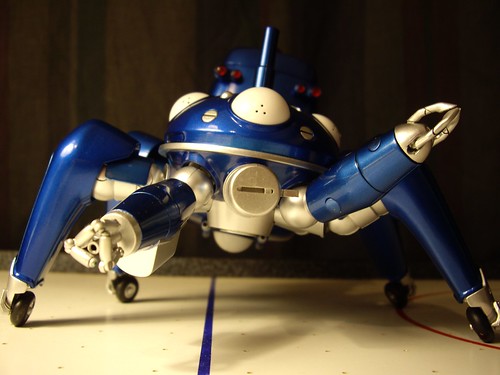
The underlying statement here is that predictable behavior results in inherent weakness. Section 9, as an organization, needs heterogeneity and even organic weakness if it is to survive. "A machine where all the parts respond the same way is a brittle tool."
Tachikoma ask questions that otherwise would not have been brought to mind, much like children that are trying to understand the world, yet with superior thinking capabilities. There are Tachikoma short clips that involve them discussing complex philosophical issues and how they relate to existence. They provide more of an innocent look on the world that surrounds them.
The Tachikomas are also used to approach the question of whether or not one's individuality can withstand a parallelization of information from a different perspective. Here, the parallelization is perfect since they are machines. In the series, they are able to retain their respective individualities through the use of external references (Batou's favorite, the one which has books, etc.), similarly to the Major.
Stand Alone Complex
While originally intended to "underscore the dilemmas and concerns that people would face if they relied too heavily on the new communications infrastructure, Stand Alone Complex eventually came to represent a phenomenon where unrelated, yet very similar actions of individuals create a seemingly concerted effort.A Stand Alone Complex can be compared to the emergent copycat behavior that often occurs after incidents such as serial murders or terrorist attacks. An incident catches the public's attention and certain types of people "get on the bandwagon", so to speak. It is particularly apparent when the incident appears to be the result of well-known political or religious beliefs, but it can also occur in response to intense media attention. For example, a mere fire, no matter the number of deaths, is just a garden variety tragedy. However, if the right kind of people begin to believe it was arson, caused by deliberate action, the threat that more arsons will be committed increases drastically.
What separates the Stand Alone Complex from normal copycat behavior is that there is no real originator of the copied action, but merely a rumor or an illusion that supposedly performed the copied action. There may be real people who are labeled as the originator, but in reality, no one started the original behavior. And in Stand Alone Complex, the facade just has to exist in the minds of the public. In other words, a potential copycat just has to believe the copied behavior happened from an originator-when it really didn't. The result is an epidemic of copied behavior having a net effect of purpose. One could say that the Stand Alone Complex is mass hysteria over nothing-yet causing an overall change in social structure.
This is not unlike the concepts of memes (refer to the conversation between the major and the Puppet Master in the manga) and second-order simulacra. It also has ties to social theory, as illustrated in the work of Frederic Jameson and Masachi Osawa.
It has been posited that the choice, by the writers of Ghost In The Shell: Stand Alone Complex, to use J.D. Salinger's short story, "The Laughing Man" as a key element in the story, was itself an example of second-order simulacra; the use of a story that could already be considered an example of second-order simulacra, by its popularity overshadowing the popularity of its original, The Man Who Laughs. This creates yet another example of the concept, by banking on the popularity of the show, the character, and the emblem used to represent The Laughing Man, supplanting the story as the Laughing Man by popularity alone.
In the series itself, it usually refers to events surrounding the Laughing Man case, and to some extents, the teamwork observed in Public Security Section 9. It is presented as an emergent phenomenon catalyzed by parallelization of the human psyche through the cyberbrain networks. A key point is that due to the electronic communications network that is increasingly permeating society, more and more people are being exposed to the same information and stimuli, making the overall psyche and responses of large groups of people increasingly similar, the result being that the potential increases exponentially for copycat behavior that forms a Standalone Complex. There is no original Laughing Man, no leader. Everyone is acting on his own, yet a coherent whole emerges. There are people who employed the copycat behavior before others, but what started the coherent whole is indefinitive.
The relation of the Stand Alone Complex to social theory is explored in more depth in the second season. A character, Kazundo Gouda, postulates that, by exploiting the mechanism of information transmission in society, one could achieve a very efficient and subtle thought control. Indeed, since people tend to modify slightly the information (and forget where it came from) in the processes of consumption (or appropriation), it becomes difficult to sort genuine ideas from modified, implanted ones. He proves to be very successful in the end.
Speaking of Media
There is plenty of Ghost in the Shell media to be had, from the manga series to the anime series and the remake of the original movie. There are also tons of fan-made content. Such as anime music videos.


![Ghost in the Shell 2.0 [Blu-ray]](https://lh3.googleusercontent.com/blogger_img_proxy/AEn0k_vjpAmYFbbvq2nP3Nx9yOX7EzKGklk_Jjiwm3qrvWaGjsnH2vZZycOGLnQC8SfQAyVFzk2IpedgDEY4HsfyC7RYn55Eqj95STe3Jk8aTsIWvce3JUA02WoIto93-sVxX6DBHtb_H-YUGYd6UD6oaZsfCfstCbljOG8tbMfs1TBYRhD5nipbD4SVoYsDKqcSPg70-NiIAuNt1u4EAbiKX-NUeToNZGKL_w=s0-d)

![Ghost in the Shell 2: Innocence [Blu-ray]](https://lh3.googleusercontent.com/blogger_img_proxy/AEn0k_th1ansoMbhhsQ5EUfnp7FppmyG9UZowvFbRQYkQGiK_38Sz2MxnYhXeiqFq_fspz3-WBMFO3_apOceLmlXIPVxd5JyNON7nUTOlHAXouRRI1_pcvEOXCoS3u4MgpFZd7Re6see06ja0Y-F9uBlhOEFIeDOyl0X094EOgkRJ0muEMqIqyb9RphUoPxhgBSY7BXiQ6_p4qAE6UghUtkzOOt_dt6pc3fAEQ=s0-d)

Created By Nostromo - Scenes from the series
Creator Unknown - Scenes from Innocence
Creator Unknown - Scenes from the original Ghost in the Shell Movie


Subscribe to:
Posts (Atom)
Unchained
Nothing like an awesome to MMV (manga music video) to mix things up. Superb editing on this video, never having a still image and run...
-
 Nothing like an awesome to MMV (manga music video) to mix things up. Superb editing on this video, never having a still image and run...
 -
 Not much to say here. Fast, action packed anime music video with a good metal song. The anime looks pretty interesting, after reading...
 -
 The editor Shin has done it once again, blending just the right song with finely picked clips from just a single anime. Have yet to se...